
Behind the Novel (Part One): Easter Eggs
SPOILER ALERT: DO NOT READ THIS IF YOU HAVEN’T YET READ THE BOOK. CONTAINS SPOILERS.
Jude Rei: In Jesus’s time, inscriptions were sometimes hung above those being crucified that described the crime for which they were being punished. References to such a sign, hung by Pontius Pilate above Jesus, can be found in the Gospels of Matthew, Mark, Luke, and John. Jesus’s crime, written in Latin, Aramaic, and Greek, was the phrase “Jesus of Nazareth, King of the Jews.” In other words, he was charged with claiming to be a king, a direct challenge to Rome. Today, references to these accusations can be found on modern crosses in the form of the abbreviation INRI, which stands for the Latin Iesus Nazarenus Rex Iudaeorum (meaning “Jesus of Nazareth, King of the Jews”). In The Thread, the antagonist’s name, Jude, is spelled identically to the German word for “Jew” (though in German, Jude would be pronounced “You-deh”). Additionally, the Portuguese word “Rei,” Jude’s last name, translates into English as “king.” As Jude explains to Lucas in the novel, it was his Nazi father’s idea of humor - referring to his son as “Jew King,” i.e., Jesus. Of course, Jude also believes himself to be a messianic figure who will transform the world through an apocalypse (albeit in ways that are antithetical to Christians, Jews, or believers of any religion). Furthering the references to his delusional self-aggrandizement, Jude’s arrival at the end of the novel is marked when his limousine pulls into the GENEsis parking garage sporting the license plate 1NR1.
Andreas Lazaros: In the New Testament, Jesus raises Lazarus of Bethany from the dead four days after his death. In The Thread, Andreas Lazaros also appears to die and come back to life. Here, however, it’s because the titanium plate in his head and the Kevlar cigarette case in his pocket protected him when he was shot by Jude’s mercenaries. In earlier iterations of the novel, Lazaros was introduced on Lazarus Saturday (which fell on April 8 in 2017), but timing and plot dictated pushing the scene forward a couple of days. Andreas Lazaros, who is Greek, uses the Greek spelling (transliterated into the Roman alphabet) of the more common name Lazarus.
NIGRI-5: The Non-human Incarnation Genetic Rendering Incubator 5 is the machine Lucas and his team at Q-Lab built to grow their cellular memory clones. Reversing the alphanumeric order and replacing the “5” with its Roman numeral equivalent, “V,” spells VIRGIN. The term “Incarnation” in this context is from the New Testament, where Jesus’s appearance on Earth is known as the Incarnation, or what the Gospel of John refers to as Jesus’s “becoming flesh.” The idea is that the machine is like a mechanical Virgin Mary that creates new life without the need for traditional parents.
Asha Lilith: Lilith, according to Jewish folklore, was Adam’s first wife. She is the ur-feminist in many ways: strong, sure of herself, stubborn, and smart. Indeed, in some versions of her story she chose to leave Adam when she refused to submit to his dominance over her, leading to her departure from the Garden of Eden. She’s sometimes associated with the owl, which is why in The Thread Lilith has a black line tattoo of one on her forearm. Although there are variations, Lilith’s hair is often depicted as being long, black, and beautiful, which is also reflected in her character.
Dr. Einsicht: Lucas’s therapist’s last name, Einsicht, translates from the German to the English as “Insight.”
Johanan: The name of the Essene character in the prologue, Johanan, comes from a real person (see Allegro, John Marco. The People of the Dead Sea Scrolls at 184, discussing pottery found at Qumran where an actual Essene had practiced writing his name, Johanan Hatilah, on the jar).
Anastasi polycephali: The name of the new genus of flatworms (planaria) that Lucas discovers in Peru’s Atacama Desert and ultimately uses for his cellular memory experiments is fictionally named Anastasi polycephali, meaning, roughly, “Resurrection of the multi-headed.”
Frau Nebel: Lucas’s family friend, a murky, nebulous character, is named Frau Nebel. In the novel, she spied on his parents for the Stasi. “Nebel” is the German word for fog.
Les Misérables, a loaf of bread, the Trolley Problem, and the Heinz Dilemma: An ongoing theme in The Thread is Lucas’s struggle with doing something bad to affect good. The idea is first introduced by Lucas’s mentor, Dr. Lee, when he talked about stealing food to save a dying man (a reference to the Heinz Dilemma, which contemplates the act of stealing medicine to save someone from dying). Later, the theme reappears in the form of the Trolley Problem that Lucas recalls from his university philosophy lecture. Lastly, the copy of Les Misérables propped up by a stone bookend carved into a loaf of bread in Dr. Einsicht’s office is also a reference to the Heinz Dilemma. It alludes to the primary protagonist in the novel, Jean Valjean, stealing bread to save his sister’s starving children.
First and last words of the novel: The book begins with “It’s begun” and ends with “It’s finished.” According to the Book of John, “It is finished” is the last thing Jesus said on the cross before dying.
Biblical references: Lucas becomes a Christ-like figure by both resurrecting himself and dying to save others. Along these lines, Arina references the Virgin Mary. Unbeknownst to Lucas, when he blows up the lab, Arina is pregnant with their child. As such, when Lucas clones Arina, he clones the fetus she is carrying as well. When her clone emerges from the NIGRI-5, she’s technically a virgin, yet pregnant. In other words, a form of Immaculate Conception. In this context, Lucas paradoxically also becomes a God-like figure whose child represents Christ.
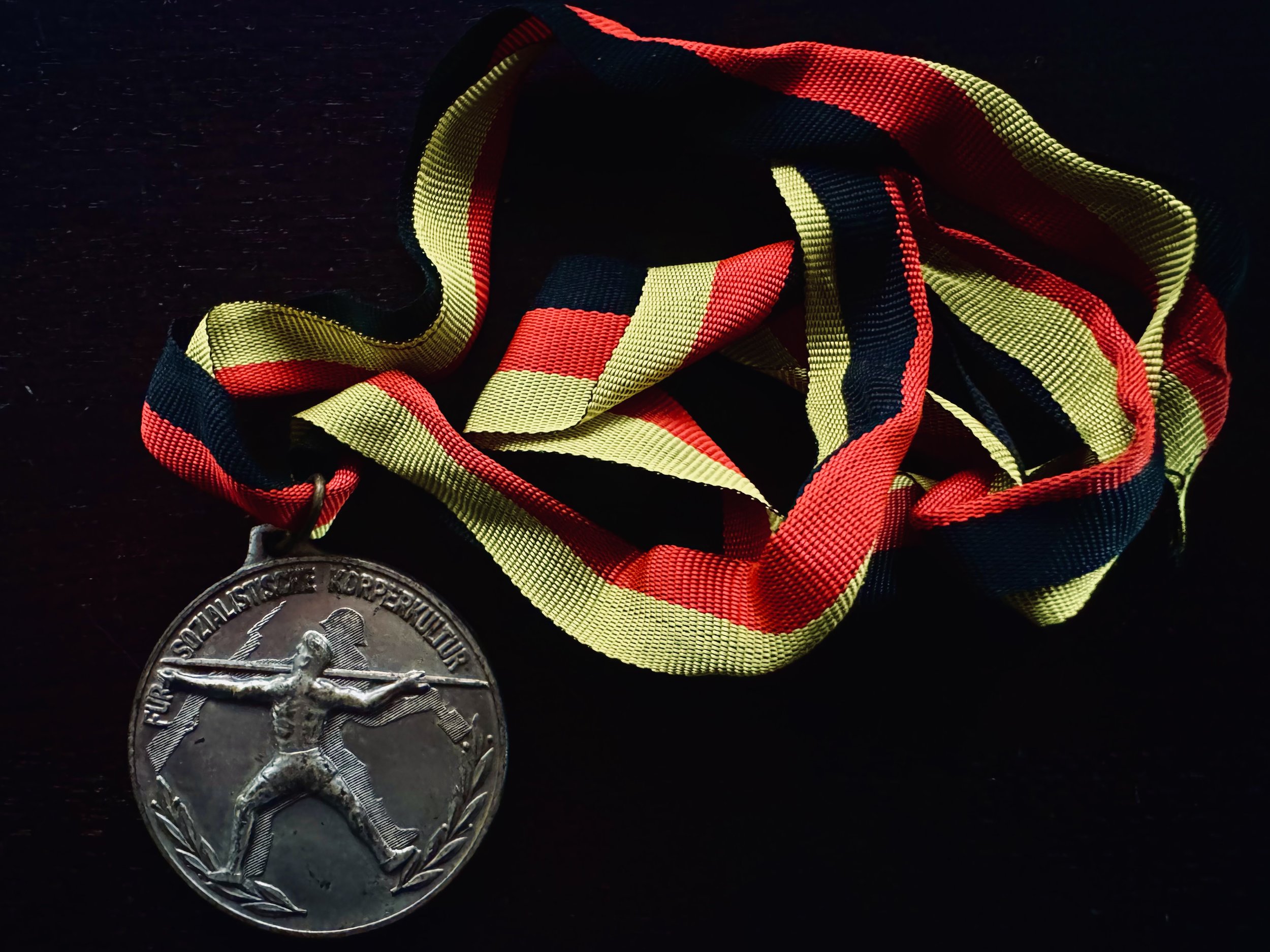
Grenade throwing at school and Lucas’s medal: I lived in the former East Germany for a year in the mid-nineties, not long after reunification. While there, a friend explained how politics and military were often interwoven into school from a young age, including amongst other things the practice of throwing grenades with wooden mockups. She later gave me a medal she’d won (see the above photo) at one of the events. That story and the remarkable medal, particularly the shadow of the javelin thrower on the back, always fascinated me, and I decided to include this bit of history in the novel as a means to explain Lucas’s familiarity with grenade throwing.
The jaguar mask in Lucas’s dream: In the dream sequence that Lucas describes to Dr. Einsicht, the man wearing the Jaguar mask represents Jude. The jaguar is the national animal of Brazil (Jude’s country of origin).
Interior graphics: Each section of The Thread begins with a graphic foreshadowing elements of the story to come:
Jar with snake and chalice: Part one is introduced with the image of a jar in which a snake is wrapped around a chalice, with a droplet of blood in the center. The jar represents the Dead Sea scroll jar in which the copper scroll is discovered, while the snake wound around the chalice alludes to the apostle John. According to some traditions (the earliest I found was a second-century apocryphal text, The Acts of John), while in Ephesus, John was given a cup filled with poisoned wine. Upon blessing the drink, the poison turned into a snake and John was able to safely drink the contents. Lastly, the droplet on the bowl of the cup represents the blood of Christ.
Silhouette of the bell tower: Part two is led by an image of a two-tiered bell tower. This represents Patmos, the setting for most of this section of the novel. Specifically, it is a loose representation of the bell tower that features prominently on the Monastery of St. John the Theologian, where the Shroud is being kept.
Chi Rho DNA symbol: The third section of the novel begins with the well-known Chi Rho symbol, referred to as a Christogram, that represents Jesus. The superimposed “X,” or Chi, and “P,” Rho, are the first two letters of the Greek word for Christ. Here, however, the traditional stem of the Rho is replaced with a DNA strand, foreshadowing the surprise plot twist that Lucas will face.
Phoenix rising: The fourth and final image is that of a phoenix rising from flames. This represents Arina’s death and return as a clone, as well as Andreas surviving the shooting in which he appeared to have been killed. The motif of this rebirth is further mirrored in both Arina’s new identity, Anastasia, meaning resurrection, as well as Andreas’s last name, Lazaros, alluding to Lazarus of Bethany from the New Testament, who Jesus raises from the dead.
Scene break graphic: Rather than using white space or traditional glyphs (e.g., ellipses, dashes, or asterisks) for page breaks (referred to as a “dinkus” in publishing), The Thread uses a vertically oriented DNA strand.
Book cover: The novel’s tagline on the cover, “Pull one strand, change the world” puts the t, a, c, and g in bold. ATCG are the four nitrogenous bases in DNA (adenine, thymine, cytosine, and guanine) that pair specifically (A with T, C with G) to encode genetic information.